Featured

Geography & Tech

Welcome to my web log! I write about geography and tech. Here are the most viewed articles on this website:

For more, just scroll down…

jon-tyson-762643-unsplash.jpg

The Myth of Techno-Governance

The myth of techno-governance. It’s one thing to name it and quite another to describe it. I studied governance during my master’s at McMaster. Specifically, top-down urban planning and the myth of Richard Florida’s creative class theory in relation to post-industrial cities around the world. It is only fitting therefore that I bring this exact exercise (although if I’m lucky, perhaps better executed) to tech.

Tech has so encroached upon our communities that I would already describe it as hegemonic. The allure of tech and its purported solutions is so strong that no one yet knows how to manage how it changes our communities. We are too caught up in its promises.

It’s one thing to communicate with others around the world at light-speed. It’s quite another to upend governance, laws, and even truth. To begin, then, I suggest a preliminary examining of the myth of tech. The lens with which we solve software challenges is at risk of being applied to many more aspects of society at a much larger scale. My intention is to identify and describe the assumptions with which this lens is forged to that we can more intentionally choose them for matters of governance and leadership.

Resources for Women in Vancouver Tech

It’s no secret that women represent an embarrassingly low percent of the technology workforce in Vancouver. So, hundreds of professional women have turned their frustrations into helpful societies, directories, forums, and communities to improve Vancouver’s gender equality quotient. I’m proud to say I know some of these women, and proud to list their services here.

I’d like to thank Jessie Kaur for her help on this post. She found descriptions for many of the links. Many of these suggestions came from Girl Gang, a Facebook group for women in Media and Communications. Thanks very much to those folks!

This is an ongoing list. Please, if you know of anything I haven’t found, let me know in the comments below.

Cheers!

BY INDUSTRY

These organizations hold events, conferences, and workshops.

The Society for Canadian Women In Science and Technology has encouraged women into science, engineering, and technology. The organization supports and promotes the education of girls and women through programs and activities that they develop in partnership with the community. They work to boost the numbers, retention and status of women in the workplace by facilitating networking, mentoring and advocating woman-friendly policies. They highlight opportunities, achievements and positive messages for and about women in the field by raising public awareness and guiding policy implementation.

The Canadian Coalition of Women in Engineering, Science, Trades and Technology promotes women in science, engineering, trades and technology, and celebrating their contributions to these fields. Annual conferences and publications on the advancement of women are central to this coalition.

Canadian Women in Communications and Technologies engages and advances women in careers in communications, digital media and technology through a coast to coast community network of industry support, leadership, education and mentoring.

Women in Engineering in Vancouver has promoted skill enhancement workshops and strong connections to a diverse group of women in engineering across workplaces, engineering fields, and universities, in the Vancouver Region.

Women in Film & Television Vancouver is a not-for-profit society that further the artistic and professional development of women in the Canadian screen-based media community. The organization recognizes and promotes the artistic and professional contributions of women in the Canadian screen-based media community and in the community at large.

Women In Games International, the Vancouver branch: a great resource for connecting with other game developers.

Ladies learning code is a great organization focussed on digital literacy.

Vancouver Film School offers a full ride 30K scholarship to one female candidate in it’s Game design program (Thank you Brenda Bailey Gershkovtich, Executive Director, Big Sisters BC Lower Mainland, past CEO Silicon Sisters for the last three links).

Power to Fly is for women working remotely in tech.

Westcoast Women in Engineering Science and Technology (WWEST) to the list. WWEST is the operating name for the 2015-2020 NSERC Chair for Women in Science and Engineering (CWSE), BC and Yukon Region. The organization’s mission is to promote science and to engage students, industry, and the community to increase the awareness and participation of women and other under-represented groups in science, technology, engineering, and mathematics (STEM). WWEST works locally and, in conjunction with the other CWSE Chairs, nationally on policy, research, advocacy, facilitation, and pilot programs that support women in science and engineering.

ENTREPRENEURSHIP

The growth of women-owned companies continues to outpace the national average. In 2015, there’s no shortage of bold, brave and brilliant females who are becoming entrepreneurs to watch and learn from.

The Vinetta Project is a female founder pitch forum and tech ecosystem based in San Francisco, New York, Toronto, Vancouver, and Washington DC. It sources high potential female founders with proven business models and offers them access to proprietary online resources, exclusive networks and capital from vetted investors. If you’re looking for seed or series A capital, enjoy networking with highly motivated people, and have a great startup idea, this is a pitch forum to join Free to pitch, $25 to attend with food and drinks.

Forum for Women Entrepreneurs provides women with the education, empowerment, and energy they need to become successful entrepreneurs. Programs and Events at FWE are designed to support and mentor women who are venturing into new business opportunities or add to existing business. From start-up advice to specific tips and tricks, FWE leaders, advisors, and business professionals share their expertise.

Young Women in Business SFU strives to engage emerging female leaders within our community by providing opportunities for personal and professional growth. They offer programs, mentorship, and networking opportunities.

Ladies Who Launch – Our primary objective is to give women access to the tools and education to take their business idea or project from inception to a rewarding and profitable endeavour. We provide resources, inspiration, support and access to a community of like-minded women you can network with; enabling you to share both your successes and struggles.

ONLINE

Girl Gang connects Metro Vancouver-based women in media, communications, tech and related fields to foster connections and support one another in our professional development. We share jobs, resources, collaboration opportunities, personal projects and feminist ephemera intended to spark conversation and inspiration.

MENTORS & NETWORKING

These forums, also mentioned in Networking in Van, are outside of the tech industry but helpful to female entrepreneurs in Vancouver:

The Women’s Enterprise Centre, by Western Economic Diversification Canada, assists women starting and growing businesses in British Columbia. Through their program, One-to-One Mentoring, Women’s Enterprise Centre brings women who are in the early stages of business together with experienced women business owners to create successful mentoring relationships.

The Beedie Graduate Business Women’s Council holds forums on female leadership and business research. If you want to nerd out on feminist statistics, I suggest dabbling here.

Crave Vancouver – Innovatively connects urban gals to the sassiest, gutsiest, most inspiring people they need to know in Vancouver. Our modern marketplace of soirees, gatherings and online networking serves as your ambassador to everything there is to CRAVE in our city.

Enterprising Mom’s Network (EMN) – Chapter meeting typically lasts for 2 hours.  The format consists of: 45-min Speaker Presentation, 15-min Networking Break, 45-min Small Group Discussion. The collaborative small group discussion setting allows you to share your success stories and inspiration, brainstorm for ideas and suggestions, ask for feedback, and support other mom entrepreneurs with your own resources and experience.  We believe that more heads are better than one!

eWomen Network – Fastest growing membership-based professional women’s networking organization in North America (according to their website). Committed to helping women and their businesses achieve, succeed and thrive in the new economy.

Forum of Women Entrepreneurs (FWE) – All who are entrepreneurially-minded. It is our mission to provide tools, energy, education and support to all women, encouraging them to become wildly successful entrepreneurs. All of their leading-edge professional programs aim to build long-term relationships and foster a strong bond between our members, advisors, speakers and high-calibre members of the business community.

Momcafe Vancouver and North Shore – Our mission is simple: To provide a forum to connect and inspire women. Through meetings, seminars and internet-based communication tools, we bring positive and inspiring role models to speak to momcafé. Their experiences and successes prove that the challenges of motherhood are no longer obstacles to having a fulfilling career, business, or community involvement. It is up to you to choose how to use their advice or experience. Facebook.

Women’s Enterprise Centre (WEC) – Put on a number of small business events and workshops throughout the year. They also partner with women’s business organizations to host special events for women entrepreneurs.

Women in Biz Network – We believe Women/Mom Entrepreneurs need opportunities to connect with other like minded individuals who can support, mentor and assist each other. Our objective is to provide supportive solutions to the established and aspiring entrepreneurs through: Workshops (breakfast & cocktail parties), Small business and marketing consulting, Biz Blogging, Small business resources, Webinars, Business Referrals.

Women Presidents’ Organization (WPO) – For women presidents of multimillion-dollar companies. The members of the WPO take part in professionally-facilitated peer advisory groups in order to bring the ‘genius out of the group’ and accelerate the growth of their businesses.

Not so passive about carbon emissions

In a city where we pride ourselves on both quality of life and living green, sustainable building design seems to have it all.

Vancouver is witnessing the rise of an increasingly popular approach to sustainable building design called the “Passive House Standard.” The standard can be applied to all building types, not just houses, and requires extra insulation, airtight windows, and optimized ventilation. High performance heat recovery ventilators supply fresh air directly to the bedroom, dining room, and living room, and exhaust stale, moisture out from the kitchen and bathrooms. The result is cleaner, healthier air and year-round comfortable temperatures throughout the entire building, even close to the windows. Equally important, they use up to 90% less energy than a standard building and the heat from a hair dryer is often enough to heat an entire home.

Goran Ostojic, Vice President of Integral Group Canada West, works on commercial Passive House buildings and says passive buildings increase employee well-being. He states that when you provide the proper environment, including lighting, fresh air, comfort, and daylight, people perform better, take fewer sick days, and experience increased productivity.

In some parts of the world, Passive House is the norm, but it wasn’t until the 2010 Vancouver Olympics that the concept was first implemented in B.C. The Austria House in Whistler was the first of its kind in Canada and introduced a new generation of builders, designers and developers such as Alexander Maurer, Principal at Market Design & Consulting and Monte Paulsen, Passive House Specialist at RDH Building Science, to this design and construction approach. In the past year, the total number of Passive House units built or under construction in Vancouver alone increased from less than 100 to over 300 with several hundred thousand square feet of additional new development currently moving through City approvals.

Harrison Heights passive house
Harrison Heights, a Passive House built by BC Housing in Smithers. Harrison Heights is a home for seniors and a few mentally challenged adults. The design is simple and repeatable. From RGH.com

Alexander Maurer notes that beyond improved building quality, Passive buildings mean energy savings for businesses and residents. Goran Ostojic says that they’re high performance, but simpler to operate and maintain. Using extra insulation reduces the size and complexity of the heating systems leading to lower energy bills and less carbon pollution.

Vancouver intends to be at the leading edge in zero emission design. The city is in an ideal position to capitalize on Passive Houses and other sustainable building designs. New buildings require high performance insulation and windows, which are produced locally. And because the emphasis is on limiting heat loss, wood becomes an excellent alternative to concrete and steel, which are known to transmit heat. is will drive local demand and innovation in wood construction materials and approaches. As this trend continues and local industry gets better at designing and building homes and offices that are very energy efficient, the better positioned Vancouver will be to export these skills and technologies to other jurisdictions and areas with similar objectives.

Two years ago, Vancouver made a bold commitment to transition out of fossil fuels and reduce carbon emissions by 80% by 2050. In order to do this, the City is focusing on improving energy efficiency and then transitioning to renewable energy in the two sectors that produce the most carbon pollution – buildings and transportation. In 2016, the City of Vancouver adopted the Zero Emissions Building Plan. The Plan takes many lessons from the Passive House standard and shifts the focus for energy efficiency innovation from a primarily technology based approach to also emphasize integrated building design and construction to reduce heat loss and improve ventilation. The Plan aims to reduce emissions from new buildings by 70% by 2020, 90% by 2025, and 100% by 2030.


This phased approach focuses on new construction and gives local industry (including designers, builders and equipment suppliers) time to develop new skills and products, and build capacity to successfully construct cost effective low-carbon buildings. The Green Building Policy for Rezonings was recently updated to reflect this new approach and will cut carbon pollution from new rezoned buildings by 50%, while still allowing builders and developers to use natural gas without increasing construction or operating costs. This approach provides flexibility to achieve GHG reductions using simple, proven approaches and technologies. The Policy’s focus on minimizing heat loss simplifies mechanical system design and enables extra investment in the building envelope. It’s this combination of focus, simplicity and cost effectiveness that enabled a diversity of organizations such as the Urban Development Institute, the Condominium Home Owners Association, and the Pembina Institute to support the new Policy.

So how effective will the City’s policy be in cutting GHG emissions? Monte Paulsen is optimistic; “The only other cost efficient approach to cutting carbon emissions out of the economy is getting people out of their car and onto bicycles or walking.”

In Vancouver, it sounds like Passive House Standards fit right in.

To learn more, email us at renewablecity@vancouver.ca


This article originally published in Business in Vancouver in August 2017.

Tarah talking tech

Last year I made a pact with myself that I would not turn down a public speaking role unless it was for a really, really good reason. Too often I think that a panel or show would be made better by including more women and minorities – a fact I can only help remedy by speaking up myself, when the opportunity comes.

The most recent of these ventures was thanks to the lovely and inspiring Tarah Ferguson, whose series, Tarah Talking Tech, highlights women in Vancouver’s tech sector working on unique and interesting projects. I am honoured to be a part of her show, and believe in what Tarah is doing. You can visit her blog here to learn more.

Telling Vancouver’s design story

When designers Kharis O’Connell and Ryan Betts attended GROW, the largest tech conference in Western Canada this year, they felt they were the only designers in the room. “Vancouver design is so insular,” Kharis noted. “Where are they all?”

This feeling of industry isolation is not unique in Vancouver. It is well documented by now that social isolation permeates industries, cultural groups, and neighbourhoods across the city. Kharis and Ryan agreed that better communication and inclusivity would improve the quality of design in the city. But how can community members help build inclusivity when they are so busy trying to make their businesses work?

When I spoke with the founders of design agency Denim and Steel, Todd Sieling and Tylor Sherman, about this challenge, they agreed that something should be done to open a conversation about design in Vancouver. “How do we level up the design community?,” we asked. “And how can we tell its story?”

Opening the Conversation

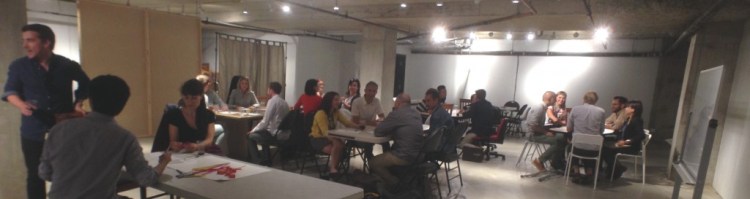
Todd and Tylor, and facilitator Amanda Fenton and I had already organized a community roundtable event for the tech startup community last March. “What do you think,” I asked them, “of doing the same thing but for design this time?” They agreed, and Kharis, Ryan, Jennifer Cutbill of Vancouver Design Week and Amanda Fenton and I started putting the pieces together for last Tuesday’s event Telling Vancouver’s Design Story. When Spring, a local accelerator, donated their secondary venue for the discussion, we had everything in place.

Design Story Vancouver.jpg

Upon their arrival, we asked attendees – designers from various sectors in Vancouver – to interview each other about the experiences they had getting to know the design community in Vancouver. “Imagine if you were newly here in Vancouver,” the first question went, “who would you connect with? Where would you find your community? And what would you be looking for? What is missing? What could help that?” And a second question: “Tell a story of a time where you felt particularly connected to Vancouver’s community and what was the positive impact of that? If you have yet to feel connected, how do you go about finding connection locally?”

Then we asked the group of forty attendees three questions, to answer in groups of five:

  1. I’d like to welcome you to share what you heard in the stories of connection. What is common about those stories? What is something that connects designers in Vancouver? Think about what do you value most? What attracts designers to Vancouver? (other than the quality of life or ‘Beautiful BC’) I’d like to invite you to describe how or why these assets and qualities are beneficial to designers. 
  2. What do we need to know that could transform the health of the Vancouver design community for the better – help it realize its potential? (not what we need to BE, what do we need to KNOW). If we had that information, how would you use it?
  3. What is something you would like to see in Vancouver, and what kind of projects would you like to work on?

After the groups exchanged ideas for about twenty minutes for each question, we asked a member of each group to speak to the room about what they had heard. This launched a fifteen minute conversation about each question. At the same time, participants were writing down their opinions and ideas on sticky notes for the wall, and tweeting #VanDesignStory tweets. Amanda calls this the “harvest.”

What We Heard

We were surprised to hear a consensus in the crowd. Yes, the design community could do a better job of welcoming people. Yes, we could be communicating to each other and to businesses in a more effective way.

We found, however, that there was a great deal of optimism around what could be done to improve the state of design in Vancouver, and that people were willing to collaborate to build projects. These ideas included a Critique Club, where you could get honest and straightforward feedback on your work; a “goodwill” competition, where agencies could work on improving the state of certain business’ web design; and an agency directory, so that newcomers could easily find who to talk to in town.

Takeaways

Names and contact information were exchanged by the end of the evening, and various groups left for the pub or to drive each other home. The evening left with a buzz – who would work on what next?

For me, the evening was a success, thanks to the research questions and the people who attended. The importance of phrasing the right question is so key to getting to the important parts of a conversation. I also learned that when you ask the right questions, it’s hard to break people out of conversation. Sometimes, that was ok – the discussions were lively. Amanda had said to bring a bell to announce the next activity. I won’t be forgetting that next time.

Finally, the two roundtable events that we’ve done have tended to go quite long – two and a half hours to three. Better food for dinner is a must for certain attendees, and although I wrote about ‘only snacks’ being available on the invite page, I think that over dinner time, it’s better to feed people than to have them pick at cookies and chips.

What is Vancouver’s Design Story? It is what we make of it. If you’d like to be a part of an ongoing discussion, please sign up for this newsletter to find out about upcoming events like this one. If you know anyone who is interested in this kind of thing, too, I’d love to talk to them about building industries with intention.

Why weareyvr?

Startup culture is a basic response to rapidly increasing social and economic disparity in the global economy. In a win-lose system, you are going to try your hardest to win. Startups do this by getting venture funding, working in small ‘agile’ groups, ‘growth hacking’, and constantly trying to improve upon the way they run their business.

In short, startup people care deeply about methodology. There is a process to finding success, they believe, and it requires deep and constant analysis. Those who work within this philosophy dogmatically believe in the scientific method for success in business. Actually, they believe in it for success in almost all things, even urban planning.

I have emerged out of university and into an arena where research methodology is exercised and discussed. Key performance indicators, statistical analysis, numbers, success metrics – startups live and die by these terms.

This philosophy birthed WeAreYVR. How can we improve the state of startups in the city (of Vancouver, Canada) if we don’t have metrics to measure? No one knows how many startups there are in the city. No one knows how many jobs are available. Every statement about digital startups in BC is based on conjecture.

WeAreYVR is meant to improve upon this. Together with Startup Genome and a number of other international databases, we are building an open data, synchronized database of startups in Vancouver. Because we like to measure things.

Helpful Links:

weareyvr

How to infuse startup culture into the client-agency relationship

Agency Startups Marketing

Originally published in The Guardian newspaper on May 28, 2015.

Focusing on the user and iteration could make for more positive and fruitful relations between agencies and clients.

Startups scurry to solve new problems in hopes of creating new markets or disrupting existing ones. They strategise for aggressive financial and geographic growth. That’s what makes them special: those that succeed really succeed.

Two central ways in which startups operate – strong user-centricity (putting the end user first in all aspects of design and output) and a focus on iteration – are fast becoming entrenched principles at leading digital agencies. This startup-like culture and methodology is enabling clients and agencies to maintain a responsive posture.

But agency work can be limited to a client’s wish lists. While these lists are a good starting point, they leave little room for boldness. This unearths a tension in our industry ̶– how can agencies raise the bar if a client already knows what they want? How should clients and agencies react when a campaign doesn’t achieve its goals? There must be a better way.

The answer, we think, lies in startup culture. Successful agency and client relationships will increasingly depend on the principles of user-centricity and iteration.

Meet your new boss: the user

For startups, customer validation is core to the development of a new and disruptive product. It proves (or disproves) the viability of the startup’s concept and helps validate its market.

For this to work in adland, agencies and clients must agree on the primacy of the user. A user-centric focus should also help agencies vet prospective clients. With user-centricity established, agencies and clients are free to select users, host testing sessions and interview users throughout product planning and development.

With this approach, users are effectively embedded in the development of any platform or campaign, but their usability is also vital. Customers must be able to easily and effectively understand concepts, agree on their relevancy and accomplish the associated tasks (as frivolous or utilitarian as they may be) as quickly as possible.

Failing your way to success

Clients must plan for a comfortable amount of experimentation and testing. Structuring the master services agreement and statement of work to accommodate retained cycles of building, measuring and learning is a vital starting point. Then, as the product develops, you will build an invaluable storehouse of ideas and behaviours for future prototyping and creative. Not only will this create a better product or campaign, it will inspire optimism in both client and agency to imagine two, three and four versions ahead.

While traditional business culture abhors failure, progressive firms welcome the learning outcomes of failure as an integral part of their creative process. The success of a product or campaign hinges on a client and agency’s ability to close this culture-gap and embrace failure. Ultimately, failure begets a campaign’s continued evolution towards the user’s wants and needs.

Different models

It’s worth noting some key differences between startups and clients. Traditional agency clients are, in ways, more sophisticated and better resourced than startups. However, they can suffer from overexposure to their own messaging. Bureaucracy may also keep decision-makers at arm’s length from their customers. Another difference is impact; the stakes are much higher when your user base is so large. Bringing startup culture to agency and client relationships is often as difficult as it sounds.

Startups, on the other hand, are only too enthusiastic to learn about their users: to flex their messaging, products and experiences accordingly. In the future, winning agencies will bridge this gap. They will foster collaborative creativity, user-centric product development and constant, persistent iteration for brands. This requires – of agencies and clients alike – the brashness and bravery of the most disruptive entrepreneur.

This is an edited extract of a feature first published in the SoDA report 2015

Jordan Eshpeter is head of client engagement and Claire Atkin is client engagement manager at Invoke Media


Sights Unseen

Sights Unseen Sad Mag

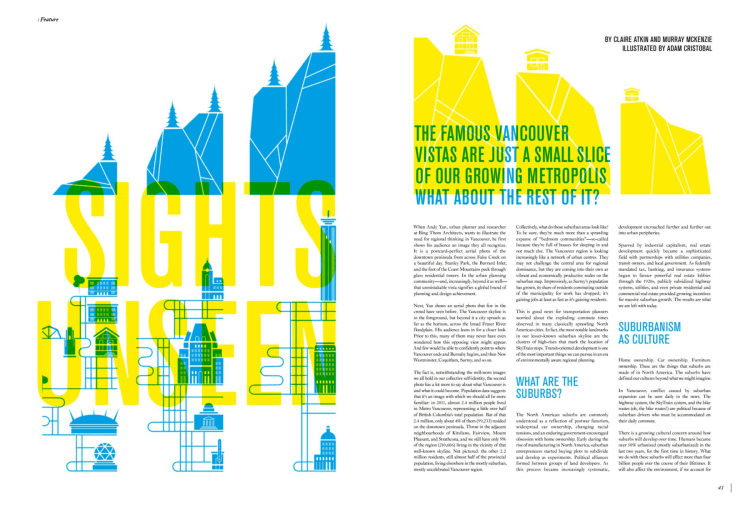
Originally published in SADMag in August 2014. By Claire Atkin and Murray McKenzie. Graphics by Adam Cristobal.

When Andy Yan, urban planner and researcher at Bing Thom Architects, wants to illustrate the need for regional thinking in Vancouver, he first shows his audience an image they all recognize. It is a postcard-perfect aerial photo of the downtown peninsula from across False Creek on a beautiful day. Stanley Park, the Burrard Inlet, and the foot of the Coast Mountains peek through glass residential towers. In the urban planning community—and, increasingly, beyond it as well— that unmistakable vista signifies a global brand of planning and design achievement.

Next, Yan shows an aerial photo that few in the crowd have seen before. The Vancouver skyline is in the foreground, but beyond it a city sprawls as far as the horizon, across the broad Fraser River floodplain. His audience leans in for a closer look. Prior to this, many of them may never have even wondered how this opposing view might appear. And few would be able to confidently point to where Vancouver ends and Burnaby begins, and then New Westminster, Coquitlam, Surrey, and so on.

The fact is, notwithstanding the well-worn images we all hold in our collective self-identity, the second photo has a lot more to say about what Vancouver is and what it could become. Population data suggests that it’s an image with which we should all be more familiar: in 2011, almost 2.4 million people lived in Metro Vancouver, representing a little over half of British Columbia’s total population. But of that 2.4 million, only about 4% of them (99,233) resided on the downtown peninsula. Throw in the adjacent neighbourhoods of Kitsilano, Fairview, Mount Pleasant, and Strathcona, and we still have only 9% of the region (210,606) living in the vicinity of that well-known skyline. Not pictured: the other 2.2 million residents, still almost half of the provincial population, living elsewhere in the mostly suburban, mostly uncelebrated Vancouver region.

Collectively, what do those suburban areas look like? To be sure, they’re much more than a sprawling expanse of “bedroom communities”—so-called because they’re full of houses for sleeping in and not much else. The Vancouver region is looking increasingly like a network of urban centres. They may not challenge the central area for regional dominance, but they are coming into their own as vibrant and economically productive nodes on the suburban map. Impressively, as Surrey’s population has grown, its share of residents commuting outside of the municipality for work has dropped; it’s gaining jobs at least as fast as it’s gaining residents.

This is good news for transportation planners worried about the exploding commute times observed in many classically sprawling North American cities. In fact, the most notable landmarks in our lesser-known suburban skyline are the clusters of high-rises that mark the location of SkyTrain stops. Transit-oriented development is one of the most important things we can pursue in an era of environmentally aware regional planning.

What are the Suburbs?

The North American suburbs are commonly understood as a reflection of postwar futurism, widespread car ownership, changing racial tensions, and an enduring government-encouraged obsession with home ownership. Early during the rise of manufacturing in North America, suburban entrepreneurs started buying plots to subdivide and develop as experiments. Political alliances formed between groups of land developers. As this process became increasingly systematic, development encroached further and further out into urban peripheries.

Spurred by industrial capitalism, real estate development quickly became a sophisticated field with partnerships with utilities companies, transit owners, and local government. As federally mandated tax, banking, and insurance systems began to favour powerful real estate lobbies through the 1920s, publicly subsidized highway systems, utilities, and even private residential and commercial real estate provided growing incentives for massive suburban growth. The results are what we are left with today.

Suburbanism as Culture

Home ownership. Car ownership. Furniture ownership. These are the things that suburbs are made of in North America. The suburbs have defined our cultures beyond what we might imagine.

In Vancouver, conflict caused by suburban expansion can be seen daily in the news. The highway system, the SkyTrain system, and the bike routes (oh, the bike routes!) are political because of suburban drivers who must be accommodated on their daily commute.

There is a growing cultural concern around how suburbs will develop over time. Humans became over 50% urbanized (mostly suburbanized) in the last two years, for the first time in history. What we do with these suburbs will affect more than four billion people over the course of their lifetimes. It will also affect the environment, if we account for climate change and the effects of transportation, building supplies, globalization, and lifestyles that suburbs encourage. As the poorest, most populated countries become more suburban, what will happen to the agricultural systems, the manufacturing systems, and the information systems? What will the long-term effects be?

In recent literature, business and land use policy has been explored as a leverage point for immigrant quality of life. In North America,Vancouver likes to bask in the international acclaim for its approach to urban planning, which many (especially self-satisfied local architects) refer to as Vancouverism. And when Vancouverism works, it really works: “mixed-use” development (residence and commerce all in one place), for example, and all of the animation and vibrancy that entails, with slender residential towers, ample public amenities, exemplary urban design, affluent urban lifestyles and gorgeous views. But is there such a thing as a suburban Vancouverism?

Indeed, it took planners a few goes at reworking their regulations in the 1970s and 1980s before Vancouver Specials finally stopped turning up. Herein lies an important lesson: Behind the achievements of Vancouverism, there is a careful, time-consuming, hands-on planning process. Planners, architects, and developers have met on an almost case-by-case basis since the mid- 1970s to negotiate the best possible design solutions for development in the downtown area. Despite numerous attempts, particularly in the most affluent residential areas, this method has proven too resource intensive to be implemented in suburban developments. Instead, they got Vancouver Specials.

But, while the design community was once derisive towards the Vancouver Special—they tended to assert a more conservative preference for the default suburban architectural styles received from California and England—times have begun to change. The Vancouver Special has been rescued from the dustbin of kitsch and now enjoys a cult following and an ironic hipness in certain circles. And more importantly, urbanists have begun to acknowledge that they provide an affordable and flexible housing solution, well liked among newcomers and multigenerational households. Their secondary suites allow for a covert form of the densification that has been effectively resisted in other, more affluent west side suburbs.
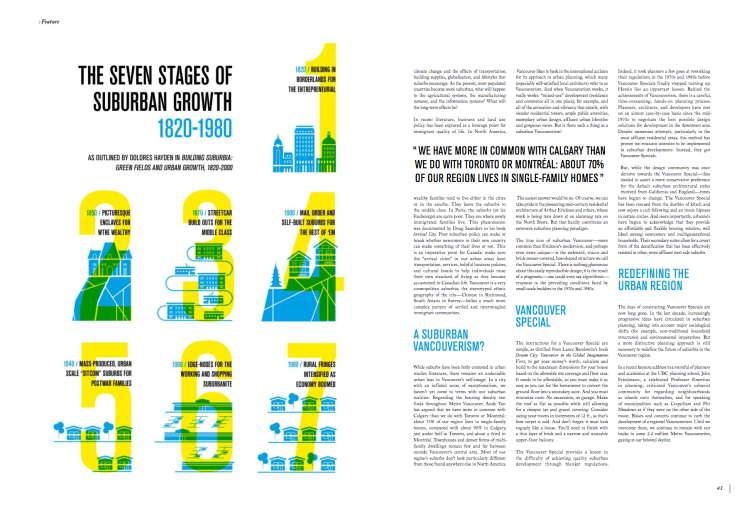
Sights Unseen Sad Mag Stages of Urban Growth

Redefining the Urban Region

The days of constructing Vancouver Specials are now long gone. In the last decade, increasingly progressive ideas have circulated in suburban planning, taking into account major sociological shifts (for example, non-traditional household structures) and environmental imperatives. But a more distinctive planning approach is still necessary to redefine the future of suburbia in the Vancouver region.

In a recent keynote address to a roomful of planners and academics at the UBC planning school, John Friedmann, a celebrated Professor Emeritus in planning, criticized Vancouver’s urbanist community for regarding neighbourhoods as islands unto themselves, and for speaking of municipalities such as Coquitlam and Pitt Meadows as if they were on the other side of the moon. Biases and conceits continue to curb the development of a regional Vancouverism. Until we overcome them, we continue to remain with our backs to some 2.2 million Metro Vancouverites, gazing at our beloved skyline.


“ We have more in common with Calgary than we do with Toronto or Montréal: about 70% of our region lives in single-family homes ”

Wealthy families tend to live either in the cities or in the exurbs. They leave the suburbs to the middle class. In Paris, the suburbs (or les Faubourgs) are quite poor. They are where newly immigrated families live. This phenomenon was documented by Doug Saunders in his book Arrival City. Poor suburban policy can make or break whether newcomers in their new country can make something of their lives or not. This is an imperative point for Canada: make sure the “arrival cities” in our urban areas have transportation, services, helpful business policies, and cultural bonds to help individuals raise their own standard of living as they become accustomed to Canadian life. Vancouver is a very cosmopolitan suburbia; the stereotyped ethnic geography of the city—Chinese in Richmond, South Asians in Surrey—belies a much more complex pattern of settled and intermingled immigrant communities.

A suburban Vancouverism?

While suburbs have been hotly contested in urban studies literature, there remains an undeniable urban bias in Vancouver’s self-image. In a city with an inflated sense of exceptionalism, we haven’t yet come to terms with our suburban realities. Regarding the housing density one finds throughout Metro Vancouver, Andy Yan has argued that we have more in common with Calgary than we do with Toronto or Montréal: about 70% of our region lives in single-family homes, compared with about 90% in Calgary, just under half in Toronto, and about a third in Montréal. Townhouses and denser forms of multi- family dwellings remain few and far between outside Vancouver’s central area. Most of our region’s suburbs don’t look particularly different from those found anywhere else in North America.

The easiest answer would be no. Of course, we can take pride in the pioneering mid-century residential architecture of Arthur Erickson and others, whose work is being torn down at an alarming rate on the North Shore. But that hardly constitutes an extensive suburban planning paradigm.

The true icon of suburban Vancouver—more common than Erickson’s modernism, and perhaps even more unique—is the awkward, stucco and brick veneer-covered, box-shaped structure we call the Vancouver Special. There is nothing glamorous about this easily reproducible design; it is the result of a pragmatic—one could even say algorithmic— response to the prevailing conditions faced by small-scale builders in the 1970s and 1980s.

Vancouver Special

The instructions for a Vancouver Special are simple, as distilled from Lance Berelowitz’s book Dream City: Vancouver in the Global Imagination. First, to get your money’s worth, calculate and build to the maximum dimensions for your house based on the allowable site coverage and floor area. It needs to be affordable, so you must make it as easy as you can for the homeowner to convert the ground floor into a secondary suite. And you must minimize costs. No excavation; no garage. Make the roof as flat as possible while still allowing for a cheaper tar and gravel covering. Consider sizing your rooms in increments of 12 ft., as that’s how carpet is sold. And don’t forget: it must look vaguely like a house. You’ll need to finish with a thin layer of brick and a narrow and unusable upper-floor balcony.

The Vancouver Special provides a lesson in the difficulty of achieving quality suburban development through blanket regulations. Indeed, it took planners a few goes at reworking their regulations in the 1970s and 1980s before Vancouver Specials finally stopped turning up. Herein lies an important lesson: Behind the achievements of Vancouverism, there is a careful, time-consuming, hands-on planning process. Planners, architects, and developers have met on an almost case-by-case basis since the mid- 1970s to negotiate the best possible design solutions for development in the downtown area. Despite numerous attempts, particularly in the most affluent residential areas, this method has proven too resource intensive to be implemented in suburban developments. Instead, they got Vancouver Specials.

But, while the design community was once derisive towards the Vancouver Special—they tended to assert a more conservative preference for the default suburban architectural styles received from California and England—times have begun to change. The Vancouver Special has been rescued from the dustbin of kitsch and now enjoys a cult following and an ironic hipness in certain circles. And more importantly, urbanists have begun to acknowledge that they provide an affordable and flexible housing solution, well liked among newcomers and multigenerational households. Their secondary suites allow for a covert form of the densification that has been effectively resisted in other, more affluent west side suburbs.

Redefining the Urban Region

The days of constructing Vancouver Specials are now long gone. In the last decade, increasingly progressive ideas have circulated in suburban planning, taking into account major sociological shifts (for example, non-traditional household structures) and environmental imperatives. But a more distinctive planning approach is still necessary to redefine the future of suburbia in the Vancouver region.

In a recent keynote address to a roomful of planners and academics at the UBC planning school, John Friedmann, a celebrated Professor Emeritus in planning, criticized Vancouver’s urbanist community for regarding neighbourhoods as islands unto themselves, and for speaking of municipalities such as Coquitlam and Pitt Meadows as if they were on the other side of the moon. Biases and conceits continue to curb the development of a regional Vancouverism. Until we overcome them, we continue to remain with our backs to some 2.2 million Metro Vancouverites, gazing at our beloved skyline.

Revitalizing Hamilton’s Heart

Revitalizing Hamilton's Heart

Since the 1960’s, post industrial downtowns across North America and Europe have suffered economic and population losses. Downtown revitalization theory is now a major subject in urban geography. Although each city is unique and requires customized revitalization techniques, certain approaches have worked better than others. Hamilton, Ontario, is a city of roughly 520,000 located just outside the Greater Toronto Area. Its downtown has struggled since the 1970’s. In the last ten years, however, certain areas of downtown have shown signs of revitalization. Conversation about this change has largely focused on attracting creative industries.

King Street, Hamilton’s most downtown street, has yet to experience significant improvement, but is surrounded by changing areas and expected to follow suit. This study looks at two theories of revitalization: the Creative Capital theory, and the Main Street approach. It also discusses commercial gentrification. City officials and business owners along King Street were interviewed about what they expect for King Street downtown. Business owners, this study found, are underutilized agents of revitalization in the area. They want and expect the area to improve, but have yet to make significant changes to their own establishments. More could be done to include incumbent business owners in King Street’s revitalization processes in Hamilton, and to acknowledge them as agents of change within the commercial gentrification literature

Abstract from: Revitalizing Hamilton’s Heart: Business Owners and the Prospects for King Street Downtown